
Deep learning models are often evaluated by a simple question:
How accurate are they?
For many applications, that is a reasonable place to begin. A model must perform its task before its internal structure becomes useful.
But accuracy alone does not tell us why a model produced a prediction, whether its reasoning is aligned with meaningful properties, or whether the explanation presented to a human reflects what actually influenced the decision.
This creates a familiar tension.
Black-box models can learn flexible representations and achieve strong predictive performance, but their internal reasoning is difficult to inspect. Fully interpretable models provide clearer explanations, but the constraints required to make them understandable may reduce their ability to represent the task.
HGC-Net — the Hybrid Guided Concept Network — was developed to explore a space between these two extremes.
Its central question is:
Can a neural network preserve an explicit channel of human-interpretable concepts without forcing all predictive information through that channel?
## What is a semantic bottleneck?
A semantic bottleneck inserts an intermediate concept layer between the learned features and the final prediction.
Instead of mapping an input directly to a class, the model follows a structure similar to:
Input → Feature Encoder → Human Concepts → Prediction
For an image classification problem, the concepts might represent properties such as:
- Is footwear?
- Is open?
- Is sport-oriented?
- Has a high shaft?
- Is an upper garment?
These concepts are supervised during training. Each corresponding neuron is expected to represent a defined property rather than an arbitrary latent feature.
The final classifier can then use those values to make its prediction.
This structure offers an appealing form of auditability. Instead of returning only a class, the model can expose concept values that a person can inspect.
If the model predicts an ankle boot, for example, we can examine whether it also recognized footwear and a high shaft.
But there is a structural cost.
## Concepts define what the model is allowed to know
A fully constrained semantic bottleneck allows the final classifier to see only the human-defined concepts.
That sounds desirable until the concept vocabulary fails to capture everything needed for the task.
FashionMNIST contains ten classes. The experimental concept layer used five human-defined properties. Those concepts describe meaningful distinctions, but they do not uniquely encode every visual difference among T-shirts, shirts, pullovers, coats, dresses, bags, trousers, sandals, sneakers, and ankle boots.
If two classes receive similar concept values, the classifier has no other information available to distinguish them.
This is not simply a training problem. It is an information problem.
The model may have discovered useful visual evidence in its encoder, but the architecture discards that evidence before the final decision because it does not correspond to one of the predefined concepts.
Interpretability therefore becomes an architectural constraint on representational capacity.
## The hybrid bottleneck
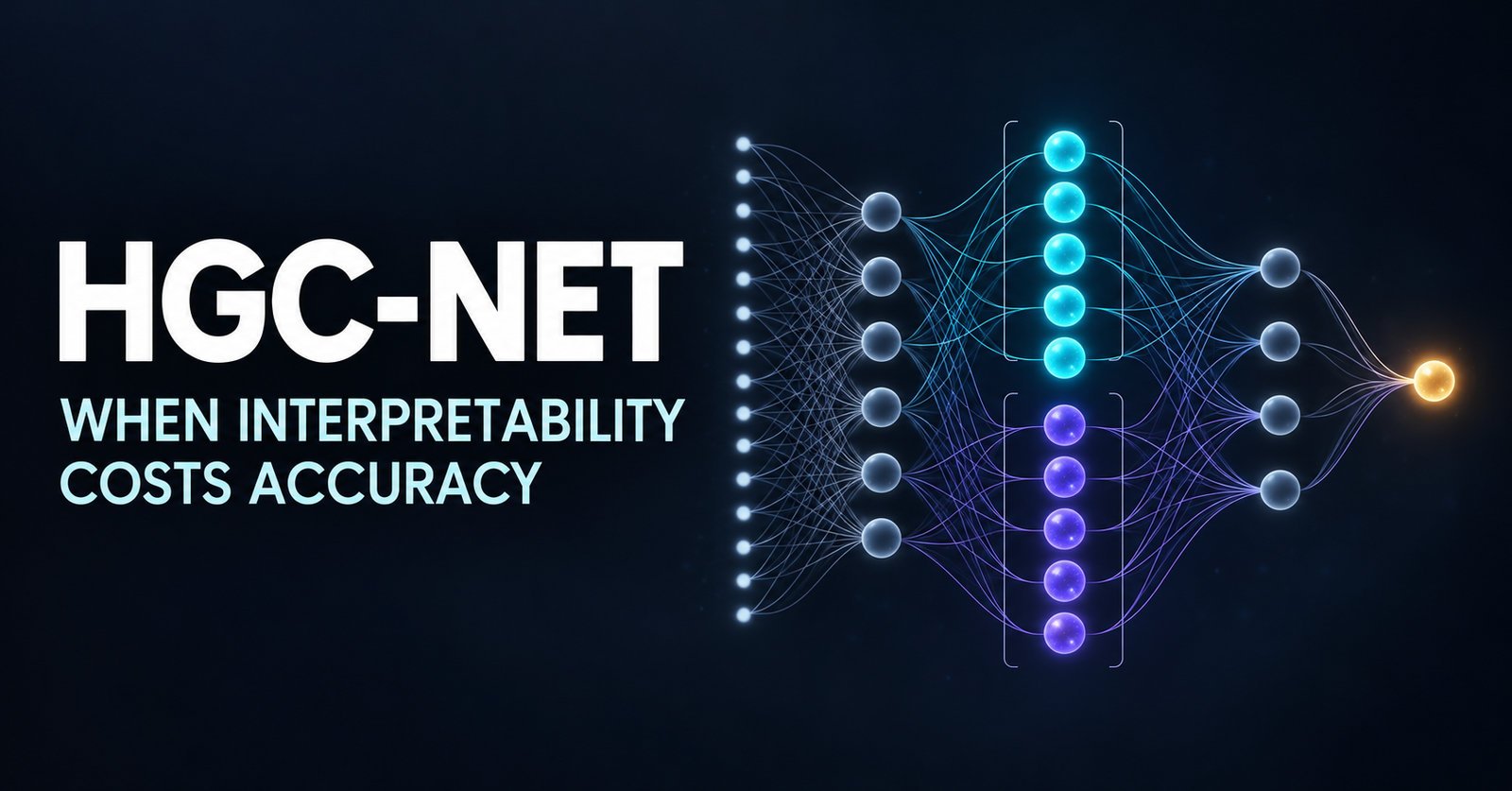
HGC-Net addresses this limitation by dividing its bottleneck into two parts:
1. Human-defined concepts
2. Free latent dimensions
The human-defined portion remains supervised and auditable. The free portion is not assigned a predefined semantic meaning and can preserve residual information needed for classification.
The resulting structure is:
Input
→ Visual Encoder
→ Hybrid Bottleneck
→ Human Concepts
→ Free Latent Dimensions
→ Final Prediction
In the FashionMNIST proof of concept, the hybrid bottleneck contained five supervised human concepts and sixteen free latent dimensions.
Training combined two objectives:
- classification loss for the final task;
- concept loss for the human-defined portion.
Only the explicit concepts received semantic supervision. The final classifier could use the complete bottleneck.
This gives the model more representational freedom than a fully interpretable concept-only network while retaining a set of values that can be inspected directly.
## What the experiments showed
The experiments compared three relevant configurations:
- a conventional CNN baseline;
- a concept-only semantic bottleneck;
- the hybrid architecture.
The conventional CNN remained the strongest overall baseline, reaching approximately 88.6% accuracy in the reported experiment.
The fully constrained bottleneck demonstrated the central difficulty: a small set of human concepts was not sufficient to represent every distinction required by the ten-class task.
The hybrid architecture recovered part of that lost capacity by introducing free latent dimensions. Across the experimental runs, its performance moved closer to the conventional model while preserving accurate supervised concepts.
But it did not establish that interpretability improves predictive accuracy.
That distinction matters.
The experiment supports the claim that a hybrid bottleneck can reduce the cost imposed by a fully constrained semantic layer. It does not demonstrate that the hybrid architecture universally outperforms an unconstrained neural network.
The baseline still had an advantage: it was free to allocate its entire representation to the classification objective.
## Is the hybrid model fully interpretable?
No—and it should not be presented as if it were.
The human concept channel is interpretable because its dimensions have defined meanings and explicit supervision.
The free latent dimensions are not inherently interpretable. Since the final classifier can use both parts of the bottleneck, the visible concepts do not necessarily explain the complete prediction.
They explain an auditable portion of the model’s representation.
This is weaker than full causal transparency, but potentially more honest than pretending that a limited concept vocabulary captures everything the network needs.
If no known human concept is active, the model can report that situation instead of inventing a semantic explanation for information represented only in the free dimensions.
The architecture therefore separates two questions:
What human-recognizable evidence did the model identify?
What additional information did the model need to preserve performance?
HGC-Net exposes the first while explicitly acknowledging the existence of the second.
## Interpretability as a budget
One way to understand the architecture is to treat representational capacity as a budget.
A conventional model spends the complete budget on predictive performance.
A concept-only model restricts the budget to dimensions that humans have named in advance.
A hybrid model reserves part of the budget for explicit concepts and leaves the rest available for representations that the concept vocabulary cannot express.
This creates several design parameters:
- How many concepts should be supervised?
- How many free dimensions should remain?
- How should classification and concept losses be weighted?
- When does a free representation dominate the explicit concepts?
- How can we measure whether the classifier actually relies on the concept channel?
These questions cannot be answered by accuracy alone.
A model may predict concepts correctly while barely using them in its final decision. Conversely, it may depend heavily on an imperfect concept and become fragile when that concept is wrong.
Further evaluation should therefore include interventions and ablations, not only observational concept accuracy.
## What still needs to be tested
HGC-Net is a proof of concept, not a finished interpretability solution.
The current experiments use FashionMNIST and concepts derived deterministically from class labels. This creates a controlled environment, but it does not reproduce the ambiguity and disagreement present in real human annotations.
A stronger evaluation should investigate:
- multiple random seeds;
- confidence intervals;
- different concept-to-latent ratios;
- loss-weight ablations;
- interventions on individual concepts;
- concept completeness;
- concept leakage;
- robustness to incorrect concept labels;
- whether predictions change consistently after concept edits;
- datasets containing ambiguous or overlapping concepts;
- comparisons with established concept bottleneck approaches.
The free dimensions also deserve separate analysis. If they encode the same properties as the explicit concepts, the model may bypass the intended semantic channel. If they encode complementary information, the hybrid design becomes more defensible.
## The real lesson from HGC-Net
The most useful result was not that one architecture defeated every other model.
It was that interpretability changes the optimization problem.
When we demand that a model communicate through predefined concepts, we decide in advance which information is considered meaningful. If that vocabulary is incomplete, the architecture may discard evidence that remains useful for prediction.
Free latent dimensions recover flexibility, but they also reduce the completeness of the explanation.
HGC-Net does not eliminate the trade-off between accuracy and interpretability.
It makes that trade-off explicit and configurable.
That may be more useful than claiming that the trade-off does not exist.
Interpretability should not be treated as a decorative visualization added after training. It is an architectural decision about what information a model may preserve, expose, hide, and use.
[Explore the HGC-Net research page](https://codebymp.com/research/hgc-net)
[Read the preprint on Zenodo](https://zenodo.org/records/18508972)
[Open the executable experiment in Google Colab](https://colab.research.google.com/drive/1q8y2zA_bUbZNOhR90QG_JTKha-pHMH7D?usp=sharing)