

Problem
Deep neural networks can achieve strong predictive performance while remaining difficult to inspect, audit, and understand. This opacity limits their suitability for safety-critical, regulated, and high-accountability applications.
Concept Bottleneck Models address this problem by forcing predictions through human-defined concepts. However, strict semantic bottlenecks may discard discriminative information that cannot be completely represented by a predefined concept vocabulary. When the available concepts are incomplete, interpretability is gained at the cost of substantial predictive degradation.
The central problem investigated by HGC-Net is therefore not whether a model should be interpretable or accurate, but how semantic supervision can be introduced without constraining the entire representation to what humans have explicitly defined.
Hypothesis / central idea
HGC-Net proposes that interpretability constraints should be applied selectively rather than uniformly.
The architecture divides its intermediate bottleneck into two complementary subspaces:
• Zhuman contains explicitly supervised, human-defined concepts that can be inspected and audited.
• Zfree contains unconstrained latent dimensions that preserve residual information not captured by the human concept vocabulary.
The hypothesis is that this separation can maintain an auditable semantic interface while recovering much of the predictive capacity lost by strict Concept Bottleneck Models.
The human concepts do not need to provide a complete description of the input. Instead, they expose the part of the representation for which meaningful semantic supervision is available, while the free latent subspace handles information that remains difficult to articulate in advance.
Architecture
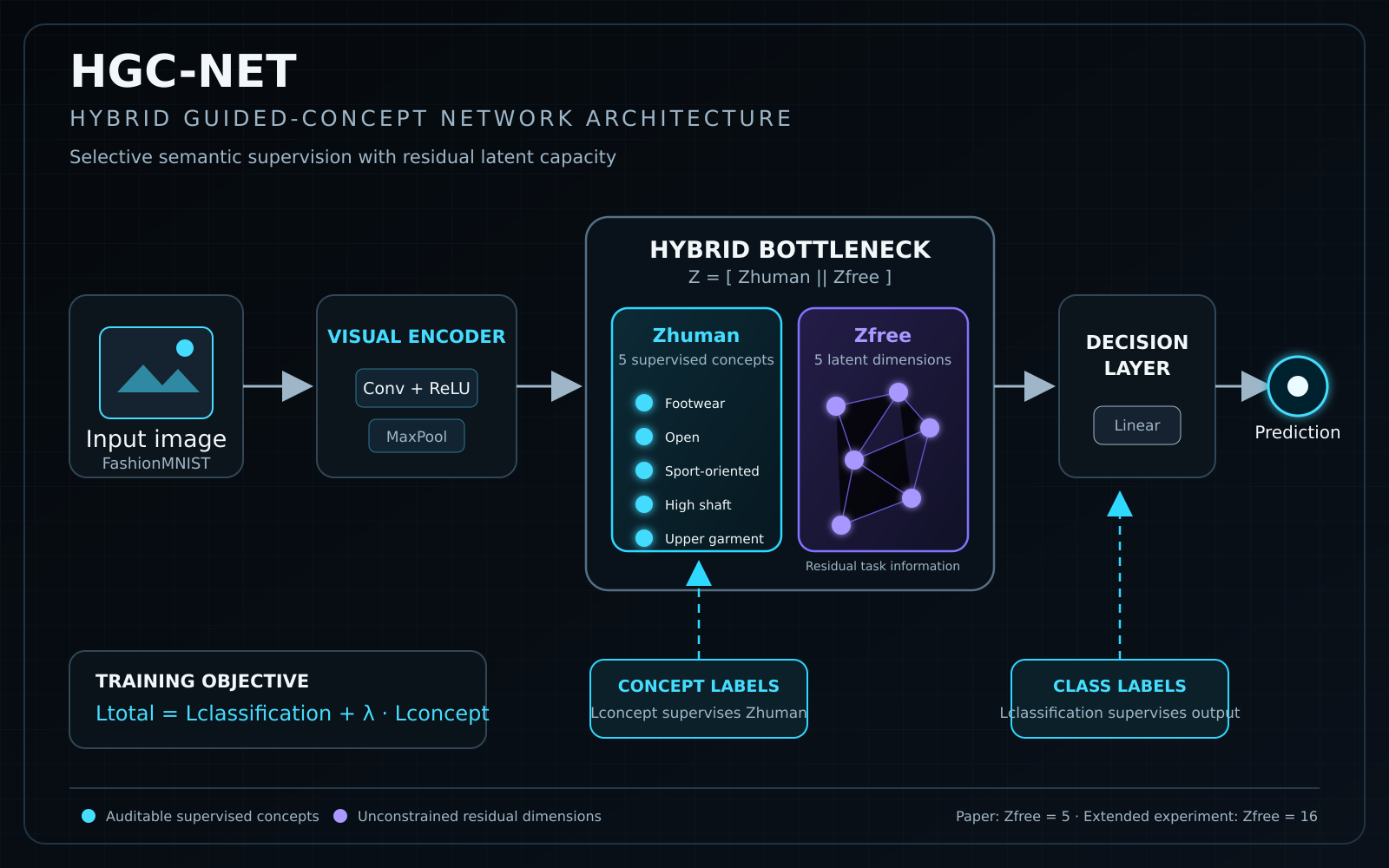
HGC-Net contains three principal stages:
Visual encoder
A convolutional encoder extracts low-level visual features from the input image. This stage is permitted to learn representations that are not directly human-interpretable.
Hybrid semantic bottleneck
The encoded representation is projected into a bottleneck defined as:
Z = [Zhuman || Zfree]
Zhuman contains supervised concept activations with explicit semantic meanings. Each dimension corresponds to an attribute defined before training and is optimized using concept annotations.
Zfree contains unconstrained latent dimensions. These dimensions capture residual visual information that the supervised concepts do not express.
Decision layer
The final classifier receives the complete hybrid bottleneck, including both Zhuman and Zfree. This allows the network to use interpretable concepts where they are available without discarding additional task-relevant information.
Because the final prediction may also depend on Zfree, HGC-Net provides an auditable semantic interface rather than a complete concept-only causal explanation. The contribution is a controlled separation between interpretable and residual representations, not the claim that every decision can be exhaustively explained through the supervised concepts alone.
Methodology
The architecture was evaluated on FashionMNIST as a controlled proof of concept. The dataset was selected because it provides visually distinct classes that can also be organized through understandable semantic attributes.
Three models were compared:
A conventional convolutional neural network used as a performance-oriented black-box baseline.
A strict Concept Bottleneck Model in which the final prediction depends exclusively on five supervised human concepts.
HGC-Net, using a hybrid bottleneck composed of five supervised human concepts and five unconstrained latent dimensions in the experiment reported in the paper.
The supervised concepts were:
• Is Footwear
• Is Open
• Is Sport-Oriented
• Has High Shaft
• Is Upper Garment
Training used a composite objective combining classification loss with concept-supervision loss. Predictive accuracy was measured on the FashionMNIST test set, while the semantic portion of the bottleneck was evaluated through concept-level accuracy and qualitative inspection of individual predictions.
After publication, an additional experiment expanded the free latent subspace from five to sixteen dimensions and obtained improved predictive performance. This extension is treated as a post-publication result and does not replace the original configuration reported in the paper.
Evidence
The original experiments reported the following FashionMNIST test results:
• Conventional CNN baseline: 89.16% classification accuracy.
• Strict Concept Bottleneck Model: 49.06% classification accuracy, with more than 99% accuracy on the supervised concepts.
• HGC-Net: 86.35% classification accuracy, with more than 98% accuracy on the supervised human concepts.
HGC-Net recovered 37.29 percentage points over the strict bottleneck model and remained only 2.81 percentage points below the conventional CNN baseline.
Qualitative analysis also demonstrated different modes of inference. For ankle boots, the model activated concepts such as “Is Footwear” and “Has High Shaft.” For categories not represented by an applicable supervised concept, such as trousers, the human concept activations remained inactive while the free latent subspace preserved sufficient information for classification.
These results support the hypothesis that incomplete human concept vocabularies do not need to become global representational constraints.
A later experiment increased Zfree from five to sixteen dimensions and produced improved predictive performance. This result strengthens the observed relationship between residual capacity and classification accuracy, although a systematic evaluation across multiple bottleneck sizes, datasets, and random seeds remains necessary.
Limitations
- FashionMNIST-only evaluation
- Human-defined concept dependency
- Incomplete semantic vocabulary
- Partial rather than complete interpretability
- Single reported experimental configuration
- Limited random-seed evaluation
- No uncertainty calibration
- No high-stakes domain validation
- Sensitivity to free-subspace dimensionality
Open questions
- What is the optimal size of the free latent subspace?
- When does Zfree become large enough to weaken the bottleneck constraint?
- How should concept completeness be measured?
- Can information leak between supervised and free representations?
- How stable are the results across random seeds?
- Does the architecture generalize to more complex datasets?
- How should contradictory or uncertain concepts be represented?
- Can the free latent subspace be inspected without assigning false semantics?
- How faithful are concept activations to the final prediction?
- How should interpretability and predictive performance be jointly evaluated?