
Problem
Contemporary artificial intelligence systems achieve remarkable generative and pattern-recognition performance, but their capabilities remain concentrated in large, predominantly monolithic models. Knowledge, reasoning procedures, behavioral tendencies, and learned associations are distributed across opaque parameter spaces, making individual capabilities difficult to inspect, update, replace, or independently verify.
This organization creates several interconnected problems. Specialized knowledge cannot easily be maintained without affecting unrelated capabilities. New learning may cause destructive interference or catastrophic forgetting. Persistent memory is frequently attached as an external retrieval mechanism without becoming part of a coherent cognitive architecture. Complex tasks still lack an explicit process for selecting the appropriate specialists, maintaining competing hypotheses, integrating heterogeneous evidence, and verifying the resulting conclusion before producing an answer.
Classical mixture-of-experts systems improve computational sparsity but normally rely on statistical token-level routing. Their experts are not necessarily aligned with interpretable knowledge domains or cognitive functions, and their gating mechanisms do not fully address the combinatorial problem of selecting coordinated expert coalitions for multidisciplinary tasks.
A modular architecture introduces another difficulty: the binding problem. Independently produced representations must be transformed into a unified interpretation without destroying their semantic structure. If every component communicates directly with every other component, communication cost and cognitive noise can grow rapidly. If integration is too restrictive, the system loses information and fragments into disconnected specialists.
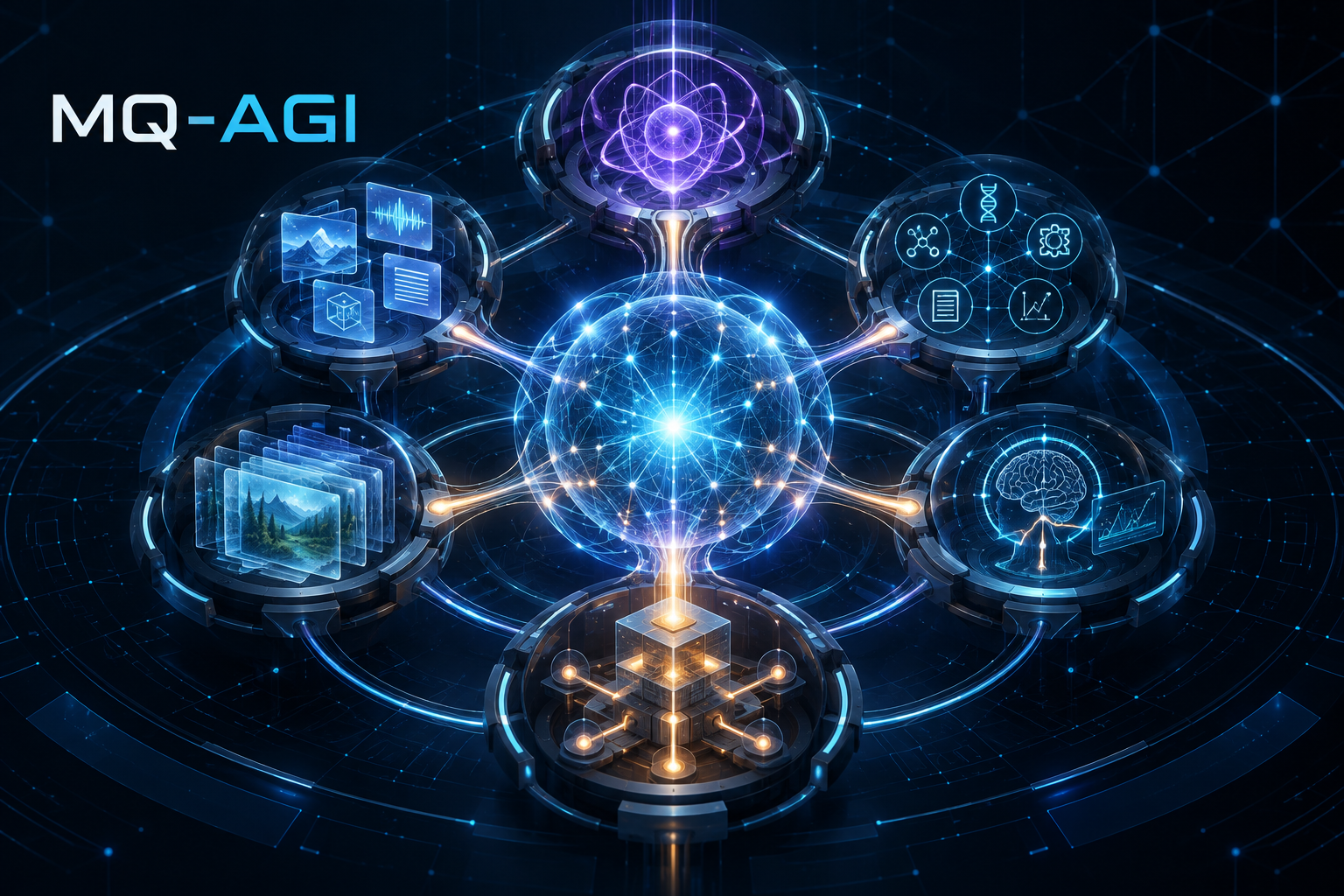
MQ-AGI investigates whether these limitations can be addressed by combining explicit neural modularity, a bounded global workspace, structured memory, metacognitive monitoring, neuro-symbolic constraints, and quantum-inspired combinatorial optimization within a single architecture.
Hypothesis / central idea
The central hypothesis of MQ-AGI is that scalable general intelligence is more likely to emerge from the coordinated interaction of specialized cognitive modules than from the indefinite expansion of a single monolithic model.
Domain Expert Networks provide fast, parallel, domain-specific processing analogous to System 1 cognition. A Global Integrator Network provides a limited-capacity workspace in which selected hypotheses, retrieved memories, symbolic constraints, and expert outputs can be compared and composed. This integrator supports slower, deliberative System 2 processes such as conflict resolution, planning, verification, and causal analysis.
The selection of an appropriate expert coalition is treated as a combinatorial optimization problem. Each expert may contribute relevant knowledge, impose a computational cost, reinforce another expert, or conflict with it. MQ-AGI proposes encoding these relationships in a QUBO or Ising-style Hamiltonian whose minimum-energy configuration represents a high-value, low-conflict coalition.
Quantum or quantum-inspired computation is therefore not proposed as a replacement for classical neural computation. Its intended role is narrower: exploring structured combinations of experts and hypotheses in a state space that can grow exponentially with the number of modules. The architecture hypothesizes that this division of labor can produce a system that is more modular, interpretable, maintainable, cognitively coherent, and capable of reasoning under uncertainty.
Architecture
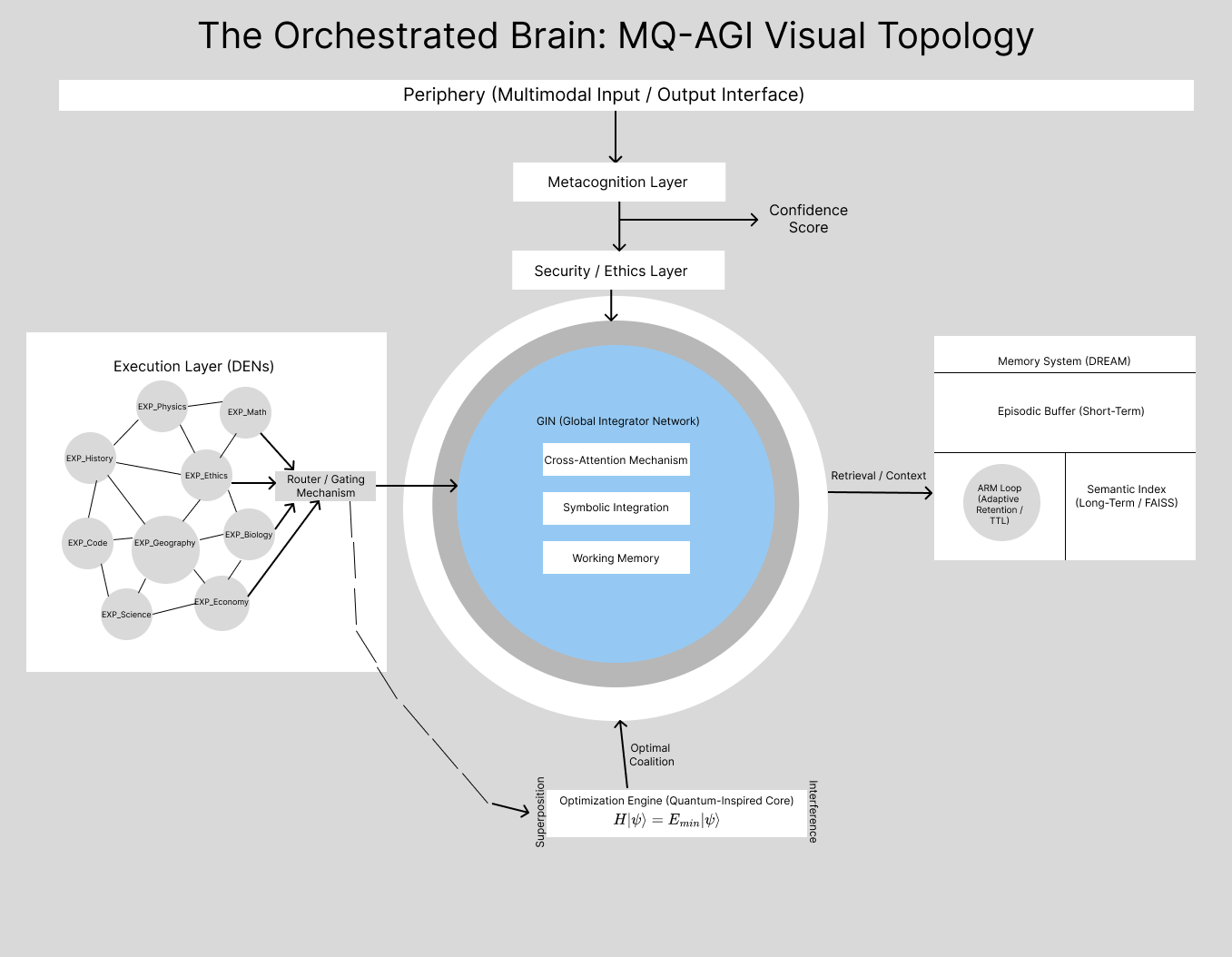
MQ-AGI is organized as a hybrid cognitive pipeline with specialized processing, global integration, structured memory, and explicit supervisory layers.
Multimodal periphery
Text, audio, visual, sensor, and other inputs enter through modality-specific encoders. These components translate heterogeneous observations into representations that can be routed to the appropriate cognitive modules. The same periphery also mediates the system’s final actions and user-facing outputs.
Router and optimization engine
A lightweight classical stage extracts relevance scores, task properties, expected resource costs, and possible relationships between experts. The coalition-selection problem is then represented as a QUBO or Ising Hamiltonian. A classical, quantum-inspired, or quantum optimizer searches for a suitable configuration of active experts.
Domain Expert Networks
Domain Expert Networks are independently trainable modules specializing in subjects or cognitive functions such as mathematics, physics, history, coding, language, ethics, vision, planning, or scientific reasoning. Different experts may use different neural topologies. Their explicit specialization supports targeted maintenance and reduces destructive interference between unrelated domains.
Global Integrator Network
The Global Integrator Network receives the selected experts’ outputs and binds them within a shared workspace. Cross-attention, symbolic integration, working memory, and consistency checks allow it to compare hypotheses, identify conflicts, preserve relevant relationships, and construct a coherent global state. It also broadcasts integrated information back to participating modules when another reasoning cycle is required.
Hierarchical memory
The memory system combines a short-term episodic buffer, semantically indexed long-term memory, and procedural knowledge. DREAM contributes adaptive retention and time-to-live policies, allowing experiences to be summarized, preserved, consolidated, or discarded. Retrieval supplies contextual evidence but does not independently determine the final conclusion.
Metacognition
A metacognitive layer observes confidence, disagreement, uncertainty, resource consumption, and prediction error. It may accept the current result, request additional specialists, retrieve more evidence, initiate another integration cycle, or ask the user for clarification.
Safety and ethics
Candidate outputs pass through explicit safety and constitutional constraints. The proposal considers neuro-symbolic verification, logical solvers, theorem provers, input sanitization, output filtering, and constraint penalties incorporated into the optimization objective.
Distributed execution
At scale, orchestrators may be partitioned by user or group through consistent hashing and session affinity. User-partitioned storage, co-location of computation and memory, and fault isolation are proposed to preserve episodic continuity while allowing horizontal expansion.
Methodology
The central hypothesis of MQ-AGI is that scalable general intelligence is more likely to emerge from the coordinated interaction of specialized cognitive modules than from the indefinite expansion of a single monolithic model.
Domain Expert Networks provide fast, parallel, domain-specific processing analogous to System 1 cognition. A Global Integrator Network provides a limited-capacity workspace in which selected hypotheses, retrieved memories, symbolic constraints, and expert outputs can be compared and composed. This integrator supports slower, deliberative System 2 processes such as conflict resolution, planning, verification, and causal analysis.
The selection of an appropriate expert coalition is treated as a combinatorial optimization problem. Each expert may contribute relevant knowledge, impose a computational cost, reinforce another expert, or conflict with it. MQ-AGI proposes encoding these relationships in a QUBO or Ising-style Hamiltonian whose minimum-energy configuration represents a high-value, low-conflict coalition.
Quantum or quantum-inspired computation is therefore not proposed as a replacement for classical neural computation. Its intended role is narrower: exploring structured combinations of experts and hypotheses in a state space that can grow exponentially with the number of modules. The architecture hypothesizes that this division of labor can produce a system that is more modular, interpretable, maintainable, cognitively coherent, and capable of reasoning under uncertainty.
Evidence
The present evidence is theoretical and architectural rather than experimental.
The research provides three complementary artifacts: a complete architectural proposal, a mathematical formalization, and a formal critical evaluation. Together, these documents define the system’s components, inference flow, memory organization, expert-routing objective, integration model, metacognitive behavior, safety mechanisms, distributed-scaling strategy, and proposed implementation roadmap.
The expert-selection mechanism is expressed as a QUBO or Ising-style optimization problem, providing a technically recognizable formulation that could be evaluated using classical solvers, quantum annealers, variational quantum algorithms, or tensor-network simulations.
The Global Integrator Network is connected to Global Workspace Theory and System 1/System 2 accounts of cognition. Its integration function is further described through category theory, while metacognitive monitoring is connected to active inference and variational free energy.
The formal evaluation identifies conceptual strengths in explicit modularity, structured integration, interpretable specialization, lifelong maintenance, and uncertainty-aware orchestration. It also identifies serious constraints, particularly classical-to-quantum transfer latency, quantum state preparation, the absence of scalable QRAM, representation translation, NISQ noise, and the operational complexity of distributed stateful systems.
These results establish conceptual coherence and produce testable hypotheses, but they do not yet constitute empirical proof of computational advantage, improved reasoning, safety guarantees, or general intelligence. Those claims require implementation, controlled benchmarks, ablation studies, latency measurements, and comparisons with strong classical baselines.
Limitations
- Conceptual architecture
- No complete prototype
- No empirical AGI validation
- No demonstrated quantum advantage
- Classical–quantum latency
- Quantum data-loading bottleneck
- Dependence on future QRAM
- NISQ noise and limited coherence
- Expert representation alignment
- Global workspace bottleneck
- Distributed-state complexity
- Unproven safety guarantees
- High implementation cost
Open questions
- Can quantum routing outperform classical sparse gating?
- Where is the classical–quantum crossover point?
- How should expert synergy and conflict be learned?
- Can heterogeneous experts share a stable latent space?
- How can the GIN preserve compositional meaning?
- How should uncertainty trigger deeper reasoning?
- Can tensor networks reproduce the proposed quantum behavior?
- How can episodic memory avoid context poisoning?
- Can safety constraints be formally verified at scale?
- How should expert modules be independently updated?
- What benchmarks can measure cognitive integration?
- How should the architecture operate without scalable QRAM?