
Problem
Persistent memory creates more than a storage problem
Artificial intelligence agents operating across multiple sessions need continuity. They must be able to retain preferences, corrections, commitments, previous decisions, and other information that remains relevant beyond a single context window. Without persistent memory, an agent repeatedly loses useful knowledge and cannot develop stable long-term interactions.
However, increasing memory capacity does not automatically improve reasoning. A stored memory may become outdated, be contradicted by newer evidence, originate from an unreliable source, lose important context through compression, or accumulate semantic distortions over repeated transformations.
A further risk emerges when retrieval and reinforcement are treated as equivalent. If a memory gains confidence merely because it was retrieved, injected into context, or repeated by the model, the system can create a recursive feedback loop:
A memory is retrieved.
The retrieved memory influences the model’s response.
The response repeats or confirms the memory.
That repetition is interpreted as new evidence.
The memory gains additional authority and becomes more likely to be reused.
Under this process, repetition can gradually be mistaken for truth. Frequently accessed errors may become increasingly influential, while rare but important information may disappear because access frequency is incorrectly treated as the primary measure of value.
Traditional retrieval pipelines also tend to treat semantic similarity as sufficient authorization. A vector search identifies relevant records and the highest-ranking results are inserted directly into the model’s context. Relevance, however, does not establish truth, reliability, temporal validity, provenance integrity, or suitability for the current task.
The central problem addressed by DREAM is therefore not simply how to store and retrieve more information. It is how to preserve useful memory while controlling when, why, and with what authority each memory may influence future reasoning.
Hypothesis / central idea
Retention is not influence
The central hypothesis of DREAM is that memory retention and memory influence must be governed as independent architectural responsibilities.
Retention answers:
How long should this memory continue to exist?
Influence answers:
Should this memory affect the current reasoning process, and with what degree of authority?
A memory may remain stored for historical continuity, auditing, user inspection, or future re-evaluation while having little or no authority in the current context. Conversely, a rarely accessed memory may remain highly important because it represents a critical correction, constraint, commitment, or safety condition.
DREAM therefore rejects several implicit assumptions commonly found in persistent-memory systems:
Retrieval is not authorization.
Repetition is not independent evidence.
Context injection is not confirmation.
Access frequency is not truth.
Persistence does not imply current validity.
A model-generated restatement does not create a new source.
Semantic similarity alone does not justify influence.
The architecture hypothesizes that separating retention from influence, preserving provenance, representing uncertainty explicitly, and recording consequential decisions can reduce false reinforcement without destroying useful continuity.
This does not mean that DREAM determines truth. Instead, it controls how stored information is admitted into a reasoning context according to explicit, inspectable, and versioned policies.
Architecture
Architectural overview
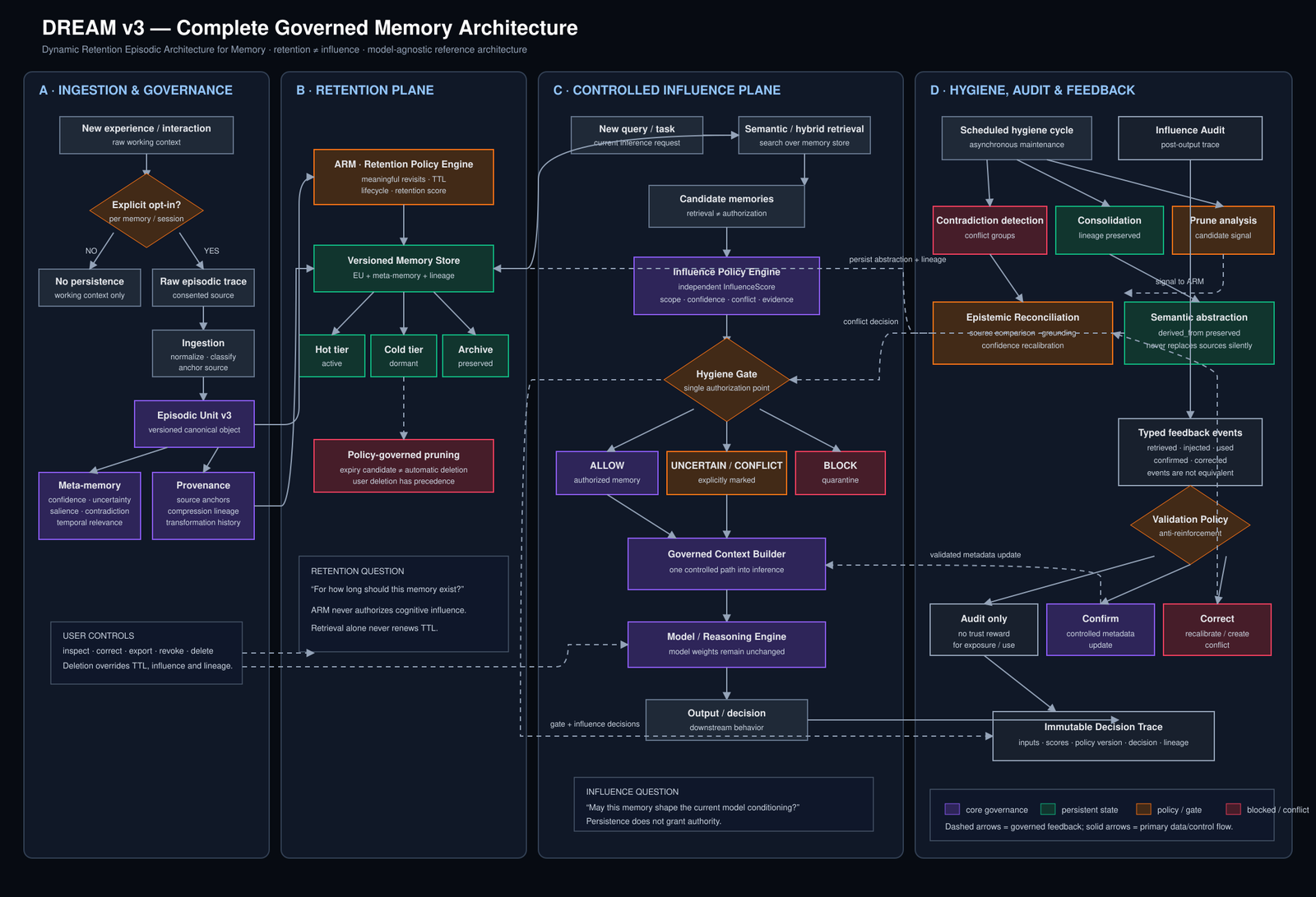
DREAM v3 is organized into four connected areas: ingestion and governance, retention, controlled influence, and asynchronous hygiene, auditing, and feedback.
1. Ingestion and governance
A new interaction begins as temporary working context. Persistent storage requires explicit authorization, allowing memory to be controlled per user, session, or memory category.
Authorized experiences are normalized, classified, and connected to their original sources before becoming versioned Episodic Units.
Each Episodic Unit can contain:
The remembered content;
Ownership and scope;
Confidence and uncertainty;
Salience and temporal relevance;
Contradiction pressure;
Grounding status;
Source reliability;
Provenance anchors;
Transformation and compression lineage;
Retention and influence metadata;
Version history.
User controls have precedence over automated policies. Memories may be inspected, corrected, exported, revoked, or deleted. Deletion overrides retention duration, influence scores, and derived lineage.
2. Retention plane
The Adaptive Retention Mechanism functions as the Retention Policy Engine. It decides whether a memory should remain active, move between storage tiers, be consolidated, archived, or become eligible for pruning.
The versioned memory store separates information into lifecycle states such as:
Hot tier: active and frequently relevant memories;
Cold tier: dormant memories preserved for possible future relevance;
Archive: records maintained for history, traceability, or explicit preservation.
Retention is affected by meaningful interaction and policy-defined signals. Retrieval alone does not renew the memory’s lifetime.
Pruning is policy-governed rather than equivalent to immediate deletion. A memory may first become a candidate for analysis, consolidation, archival, or removal. Explicit user deletion always takes precedence.
3. Controlled influence plane
When a new query arrives, semantic or hybrid retrieval returns candidate memories. These candidates are not immediately inserted into the reasoning context.
The Influence Policy Engine calculates a query-conditioned Influence Score using factors such as relevance, confidence, contradiction pressure, temporal validity, evidence quality, source reliability, scope, and provenance integrity.
The candidate then passes through the Hygiene Gate, the single authorization point between retrieval and context construction. Depending on the memory’s epistemic state, the gate may:
ALLOW: authorize the memory as usable context;
ALLOW AS UNCERTAIN: include it with explicit uncertainty;
ARBITRATE: preserve a material conflict for comparison;
LOW INFLUENCE: retain the memory without normally injecting it;
QUARANTINE: isolate it because of epistemic risk;
BLOCK: prohibit it from influencing the current context;
CONSOLIDATE: schedule redundant memories for lineage-preserving abstraction.
Only memories authorized by this process reach the Governed Context Builder. The downstream model receives controlled context, while its internal weights and inference mechanism remain unchanged.
4. Hygiene, audit, and feedback
An asynchronous maintenance plane operates independently from immediate query execution. It performs:
Contradiction detection;
Evidence reconciliation;
Epistemic recalibration;
Lineage-preserving consolidation;
Semantic abstraction;
Pruning analysis;
Versioned metadata updates.
Semantic abstractions do not silently replace their sources. Derived records preserve links to the original memories and their transformation history.
The feedback system distinguishes between events such as retrieval, injection, use, confirmation, correction, and failure. These events are deliberately non-equivalent: merely retrieving or exposing a memory does not increase its epistemic authority.
Consequential memory decisions produce immutable decision traces serialized through canonical JSON and connected through a hash chain. Each trace records the inputs, evaluated features, policy version, authorization decision, reasons, and relevant provenance.
This structure makes memory influence inspectable without claiming that the system itself possesses perfect knowledge or universal truth-detection capability.
Methodology
Research and development methodology
DREAM was developed through iterative architectural design, executable reference implementations, controlled simulation, scenario-based evaluation, and component-ablation analysis.
Architectural evolution
The project preserves its major versions separately so that changes in assumptions, mechanisms, and evidence remain traceable.
DREAM v1 introduced Episodic Units, semantic retrieval, explicit opt-in persistence, adaptive retention, lifecycle management, and infrastructure-independent orchestration.
DREAM v2 expanded the proposal through quantitative retention simulations, storage-growth analysis, energy-related cost proxies, modular Python implementations, and DREAM-as-a-Support, which positioned the architecture as a reusable memory layer.
DREAM v3 separated retention from influence and introduced governed context construction, meta-memory, provenance lineage, contradiction handling, epistemic recalibration, immutable traces, and the Hygiene Gate.
Executable reference implementation
The current version includes a model-independent Python reference core. It implements the principal contracts and decision flows without requiring an external language model or third-party runtime dependency.
Automated unit and integration tests verify policy behavior, memory-state transitions, provenance handling, decision tracing, and maintenance operations.
Scenario-based evaluation
The controlled benchmark evaluates seven synthetic scenario families:
Stable preferences;
Changed preferences;
Corrected facts;
Repeated errors;
Conflicting sources;
Broken compression lineage;
Rare but critical memories.
These scenarios were selected to test continuity and epistemic safety under different forms of memory change, contradiction, repetition, and provenance degradation.
Baseline comparison
The evaluation compares five system configurations:
No persistent memory;
Simple retrieval-augmented generation;
Permanent memory;
A DREAM v2-style retention baseline;
The complete DREAM v3 governance pipeline.
Component-ablation analysis
Individual governance mechanisms are removed or disabled to measure their contribution to the complete system. The ablation framework executes thousands of generated configurations and evaluates how architectural changes affect grounding fidelity, false reinforcement, continuity loss, and quarantine behavior.
Scope of the evidence
The methodology evaluates the deterministic behavior of the architecture under controlled synthetic conditions. It does not evaluate the general intelligence, factual accuracy, or internal neural representations of a language model. The results should therefore be interpreted as evidence about the governance pipeline, not as evidence of universal real-world performance.
Evidence
Controlled experimental evidence
DREAM v3 was evaluated using a controlled synthetic benchmark covering seven scenario families and five memory-system configurations.
Within this environment, the complete governance pipeline achieved:
100% grounding fidelity: authorized memories preserved the expected connection to their supporting sources.
0% false reinforcement: forbidden or invalid reinforcement paths were blocked in the evaluated scenarios.
0% continuity loss: critical memories expected to remain available were preserved.
100% quarantine recall: memories designed to trigger quarantine were identified in the controlled scenarios.
The component-ablation study executed 7,000 generated configuration runs. Removing the separation between retention and influence caused the largest architectural degradation and produced an approximately 34.3% false reinforcement rate.
This result supports the architectural claim that a policy responsible for deciding whether a memory continues to exist should not automatically determine whether that memory may influence current reasoning.
The release also contains a model-independent Python reference implementation, an interactive local governance playground, automated regression tests, synthetic datasets, formal contracts, reproducibility documentation, and architecture diagrams.
These results are controlled architecture-level evidence. They demonstrate that the implemented rules behave as intended within the evaluated synthetic scenarios. They do not demonstrate universal generalization, real-world reliability, language-model truthfulness, or production-scale performance.
Limitations
- Controlled synthetic evaluation
- No natural-conversation validation
- No production-scale deployment
- No multilingual evaluation
- No adversarial workload evaluation
- Policy weights are not proven optimal
- Does not determine universal truth
- Does not eliminate hallucinations
- Does not modify model weights
- Not a complete cognitive architecture
- Reference prototype, not a production service
- Limited external replication
Open questions
- How should influence policies adapt over time?
- How should conflicting memories be reconciled?
- How can semantic drift be measured longitudinally?
- Which signals should count as independent confirmation?
- How should source reliability be calibrated?
- How should rare but critical memories be protected?
- How can governance policies resist adversarial memories?
- How does DREAM perform with real language models?
- How does the architecture scale to production workloads?
- How should multilingual memories share provenance?
- How can policy weights be learned without recursive reinforcement?
- How should privacy, deletion, and derived lineage interact?