
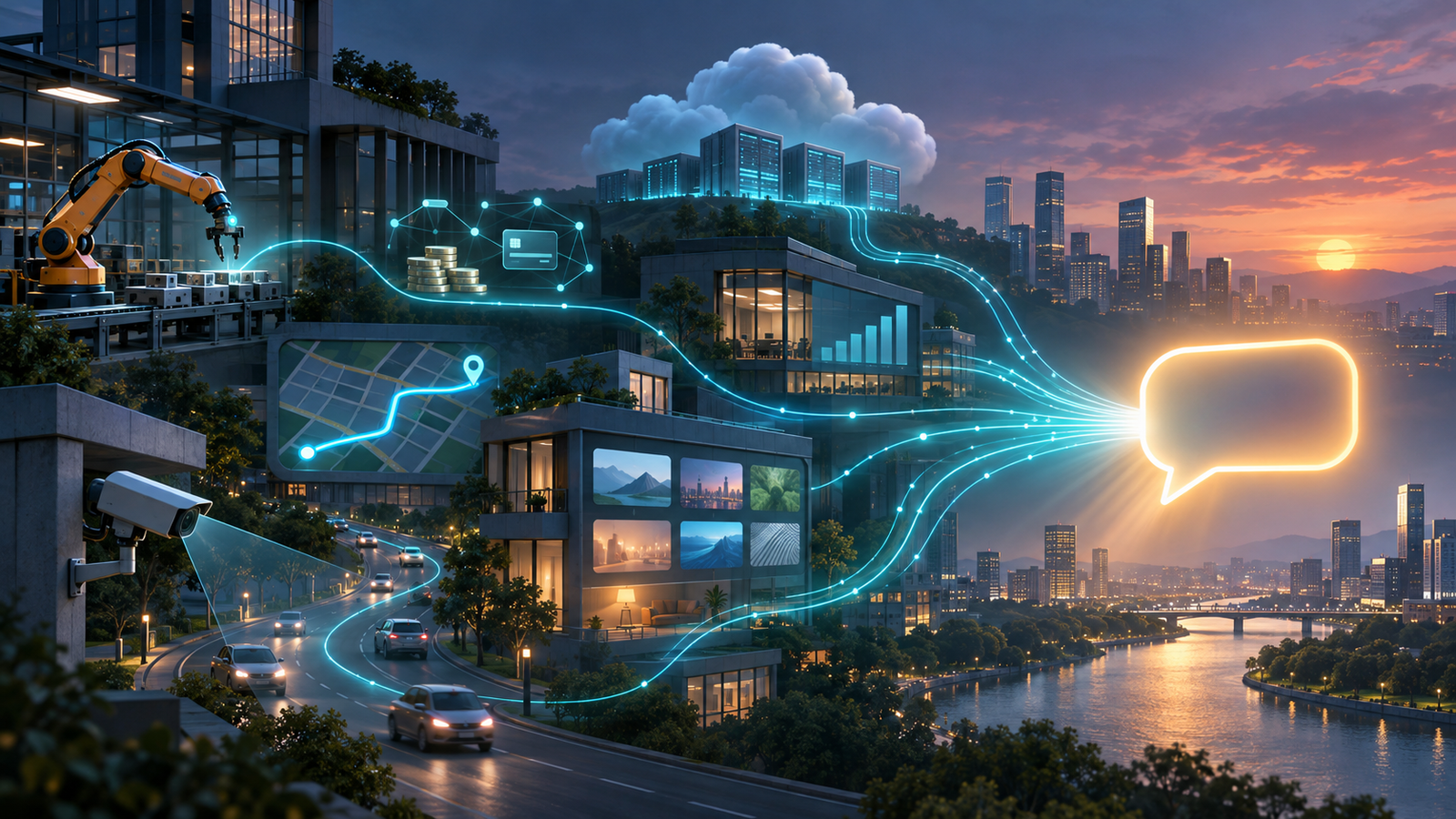
The revolution that appeared to arrive overnight
On November 30, 2022, OpenAI introduced ChatGPT as a research preview.
For millions of people, this appeared to mark the arrival of artificial intelligence.
A person could write a question in natural language and receive a coherent answer. The system could explain concepts, generate text, follow instructions, maintain a conversation, revise its responses, and perform tasks that previously seemed inseparable from human language.
Artificial intelligence suddenly felt real.
But the AI revolution did not begin on that day.
Long before people started talking directly to generative models, artificial intelligence had already entered search engines, recommendation systems, financial services, industrial processes, navigation applications, fraud detection, translation tools, digital cameras, entertainment platforms, and decision-support systems.
ChatGPT did not create this revolution.
It gave the revolution a face.
A revolution researchers had anticipated
While reading Artificial Intelligence and Machine Learning: Theoretical Aspects and Applications, by Oscar Gabriel Filho, I encountered a passage describing what AI researchers expected for the first decades of the twenty-first century.
The author refers to:
“a true technological revolution arising from the massive use of AI techniques.”
The anticipated applications included decision-support products, natural language processing, and systems intended for personal and commercial use.
The book was published in 2023, so this passage should not be treated as a prediction made by the author decades earlier. It appears in a historical overview of artificial intelligence and summarizes expectations that developed throughout the field.
That distinction matters.
However, the passage still raises an interesting question:
Did that technological revolution actually happen?
The answer is yes—but not exactly in the form most people expected.
AI became infrastructure before it became conversation
Popular culture often represented artificial intelligence as a visible entity.
AI was imagined as a robot, an autonomous machine, a talking computer, or a synthetic mind with a recognizable personality. Under this image, the arrival of AI would be an identifiable event. People would see the intelligent machine and understand that a new technological era had begun.
The real transition was more gradual.
Artificial intelligence entered society as infrastructure.
A search engine ranked pages according to their probable relevance. A streaming platform predicted which film a person might watch next. A bank evaluated whether a transaction differed from the customer’s normal behavior. A navigation application estimated traffic conditions and selected a route. An email service classified suspicious messages as spam.
These systems did not normally introduce themselves as artificial intelligence.
They simply worked inside products.
This made AI simultaneously widespread and difficult to perceive. People could interact with machine-learning systems dozens of times a day while believing that artificial intelligence still belonged to laboratories, science fiction, or some distant future.
The revolution was already underway, but it was hidden behind interfaces designed to make the underlying complexity disappear.
Decision support became one of AI’s quietest successes
The passage from Gabriel Filho’s book specifically mentions decision-support products.
This is one of the areas in which the anticipated diffusion of AI became particularly visible—although often only to the organizations deploying it.
Artificial intelligence can help identify patterns in quantities of data that would be difficult for a person to inspect manually. This capability has been applied to tasks such as:
detecting unusual financial transactions;
estimating credit and operational risks;
forecasting demand;
optimizing routes and inventories;
identifying industrial failures;
prioritizing medical cases;
recommending products;
classifying documents;
supporting maintenance decisions;
and predicting equipment behavior.
In most of these situations, the AI system does not need to replace the human decision-maker completely.
It can organize information, estimate probabilities, flag anomalies, compare scenarios, or recommend possible actions. The human remains responsible for interpreting the result and deciding what should happen.
This is less dramatic than the image of an autonomous machine taking control of an organization, but it is much closer to the way AI has actually transformed commercial and industrial activity.
The revolution did not always remove the person from the decision.
Often, it changed what the person could see before deciding.
Natural language changed public perception
The transformation became more visible when artificial intelligence stopped operating only behind interfaces and began communicating through them.
Natural language processing had already powered search, translation, speech recognition, text classification, and digital assistants for years. A 2016 Stanford report observed that AI technologies were already entering everyday life and that natural language processing was moving toward systems capable of interacting through dialogue rather than responding only to rigid commands. ai100.stanford.edu
The introduction of the Transformer architecture in 2017 accelerated this development. Its attention-based design provided an effective and highly parallelizable foundation for processing sequences, initially demonstrating strong results in machine translation. research.google
Subsequent language models increased in scale, capability, and accessibility.
Then conversational interfaces changed the relationship between the technology and its users.
Before generative AI, the user usually interacted with the product while the AI remained hidden inside it.
With conversational models, the user began interacting with the AI itself.
That difference was psychological as much as technical.
A recommendation algorithm might influence what someone watched without being perceived as an intelligent entity. A conversational model, however, appeared to interpret a request, formulate an answer, and respond in real time.
AI had been present for years.
Now it had a voice.
What the expectation got right
The expectation described by Gabriel Filho was accurate in several important respects.
AI reached personal products
Artificial intelligence became part of phones, cameras, home devices, vehicles, streaming services, social networks, productivity tools, and online platforms.
Even when consumers did not purchase a product specifically because it contained AI, they benefited from features made possible or improved by machine learning.
AI became commercially valuable
Companies applied AI to advertising, logistics, customer service, financial analysis, security, manufacturing, recommendation systems, software development, and business intelligence.
The technology became more than an academic research field. It became an economic capability.
Decision support became widespread
AI systems began assisting people and organizations in classification, prediction, risk analysis, prioritization, and optimization.
Their influence extended beyond autonomous systems. Many of their most valuable uses appeared in tools that augmented human decisions.
Natural language became a major interface
Language processing evolved from specialized classification and translation systems into general-purpose conversational interfaces capable of serving millions of users.
This was perhaps the most visible confirmation of the expectation that natural language would become a central area of AI application.
AI spread across sectors rather than remaining a single industry
The revolution did not produce one universal “AI product.”
Instead, AI became a technical layer used in healthcare, transportation, education, finance, entertainment, manufacturing, security, communication, and many other fields.
In 2016, Stanford’s One Hundred Year Study was already examining AI’s impact across transportation, home robotics, healthcare, education, public safety, employment, and entertainment. The report described AI as a force already beginning to transform daily life. ai100.stanford.edu
What popular imagination got wrong
Recognizing that the revolution happened does not mean every prediction about artificial intelligence was correct.
Some expectations were premature. Others imagined the wrong form of adoption.
General-purpose domestic robots did not become as common as smartphones. Fully autonomous vehicles did not replace conventional transportation within the most optimistic timelines. Medical AI did not eliminate the structural, regulatory, and human difficulties of healthcare. Truly general machine intelligence remained an open research problem.
The revolution also did not arrive as a single central intelligence.
It emerged through millions of specialized models, services, sensors, APIs, devices, applications, and automated decisions.
The intelligence was distributed.
A model classified an image. Another estimated demand. Another detected fraud. Another ranked search results. Another translated a sentence. Another recommended a song.
Individually, many of these systems appeared limited.
Together, they changed the structure of digital life.
The popular imagination looked for one machine intelligent enough to announce the future. Meanwhile, thousands of narrow systems quietly constructed it.
The AI winters did not mean the field was dead
The history of artificial intelligence was not a continuous sequence of success.
Periods of strong optimism were followed by disappointment, reduced investment, and criticism. Systems that performed well in controlled demonstrations often struggled with the complexity of the real world. Computational resources were limited, data was scarce, and some promises exceeded what existing methods could deliver.
These periods became known as AI winters.
Yet the fundamental ideas did not disappear.
Symbolic reasoning, neural networks, statistical learning, optimization, computer vision, language processing, and robotics continued to develop. Some techniques waited decades for sufficient data and computing power. Others were combined with new architectures or applied to problems that earlier researchers could not address at scale.
Progress did not always resemble a straight line.
Sometimes an idea arrived before the infrastructure capable of making it useful.
The current revolution was therefore not created from nothing. It emerged from decades of accumulated research, repeated failures, improved hardware, larger datasets, new economic incentives, and the gradual integration of AI into software products.
Visibility is not the same as existence
ChatGPT’s public release in 2022 was a genuine technological and cultural milestone. OpenAI presented it as a conversational model capable of answering follow-up questions, challenging incorrect premises, acknowledging mistakes, and rejecting certain requests. OpenAI
But its importance should not erase everything that came before it.
The public release of conversational AI changed visibility.
It allowed ordinary users to test the technology directly, without needing to understand programming, machine learning, data pipelines, or specialized interfaces. The capabilities and limitations of AI could now be experienced through language.
This made the revolution feel sudden.
Technologically, it was the result of a long accumulation.
Socially, it was an explosion.
The next revolution may also arrive quietly
If the first major wave of AI became infrastructure before becoming visible, the next transformation may follow the same pattern.
AI agents may gradually move from generating answers to completing multi-step tasks. Persistent-memory systems may allow applications to preserve context across sessions. Models may coordinate tools, software, sensors, and other models. Robotics may become useful first in warehouses, hospitals, farms, and factories before becoming common in homes.
At first, these changes may appear to be isolated product improvements.
An assistant remembers a preference. A system negotiates between services. A machine schedules and completes a task. An application detects that previous information is outdated. A robot performs one narrow physical activity reliably.
Individually, none may appear revolutionary.
Together, they may represent a transition from AI that produces information to AI that preserves context and acts over time.
This transition will introduce new questions.
If an AI system remembers information, which memories should influence its decisions? If it acts autonomously, how should authority be limited? If multiple models cooperate, where does responsibility remain? If a system changes through accumulated experience, how can its behavior remain understandable?
The next phase will not be defined only by greater intelligence.
It will also be defined by governance, memory, authorization, accountability, and control.
The revolution became visible suddenly
Artificial intelligence did not enter society through a single door.
It entered through search results, financial systems, recommendation engines, industrial controls, cameras, navigation tools, translation services, and countless automated decisions.
For years, it remained present without appearing to be present.
Generative AI changed that perception because language allowed people to encounter the technology directly. The revolution that had been distributed across infrastructure acquired an interface that anyone could understand.
The researchers were right that AI would spread through decision support, natural language, personal products, and commercial systems.
But the most important lesson may be how that future arrived.
Not as one dramatic moment.
Not as a single intelligent machine.
Not as a robot announcing the beginning of a new era.
The AI revolution developed gradually and became visible suddenly.
And the next one may already be happening in the same way.
References
Gabriel Filho, Oscar. Artificial Intelligence and Machine Learning: Theoretical Aspects and Applications. Blucher, 2023.
Stone, Peter et al. Artificial Intelligence and Life in 2030. One Hundred Year Study on Artificial Intelligence, Stanford University, 2016.
Vaswani, Ashish et al. Attention Is All You Need. NeurIPS, 2017.
OpenAI. Introducing ChatGPT. November 30, 2022.