
Problem
Traditional software contracts describe available structures but rarely reveal how those structures are actually consumed. Interfaces, DTOs, schemas, and payload definitions may expose fields globally while leaving the real dependency surface hidden inside application code.
As systems evolve, this implicit coupling creates uncertainty. Adding a field may be harmless, but renaming, deprecating, or removing one can affect an unknown number of consumers. Compatibility is then treated as a global property of a contract or version, even when different consumers depend on completely different subsets of information.
Version numbers become coordination mechanisms rather than records of evolution. Renames are frequently modeled as deletion followed by addition, semantic history is lost, and breaking changes remain invisible until a consumer fails.
The central problem Raygon addresses is therefore not data representation. It is the absence of an explicit and inspectable model of who depends on what, why that dependency exists, and how it is affected by change.
Motivation
Raygon was created from the idea that software coupling should be declared rather than inferred after failure.
A consumer should not automatically depend on an entire contract simply because the contract is available. It should explicitly declare the fields and semantic capabilities it requires. This declared projection becomes the observable boundary of its dependency.
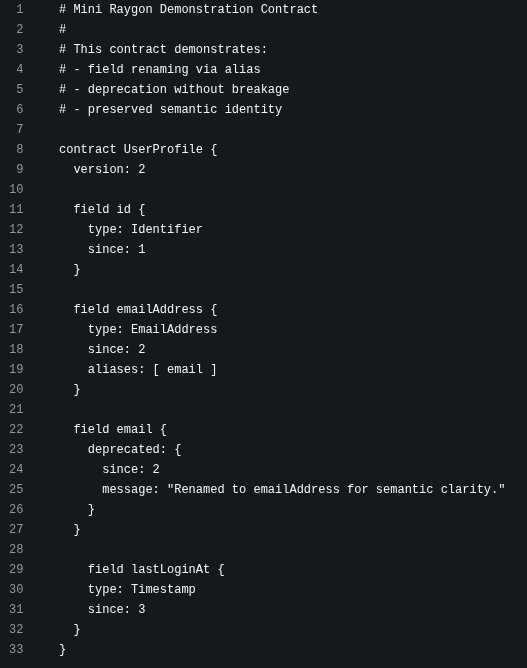
By modeling consumption directly, Raygon changes compatibility from a global assumption into a local and attributable relationship. A change affects only the consumers that explicitly depend on the modified semantic element. Additive evolution remains safe, field renames can preserve identity through aliases, and deprecations can be recorded without erasing historical meaning.
The objective is not to replace JSON, TypeScript, OpenAPI, GraphQL, or existing validation systems. Raygon operates at a different level: it models dependency, intent, semantic identity, and evolution independently of representation, language, transport, or runtime.
Architecture
Raygon is divided into two related but independent artifacts.
The Raygon Contract Model is the authoritative specification. It defines contracts, fields, projections, semantic identity, localized compatibility, version-aware evolution, aliases, deprecation, and append-only field lineage. The model is language- and platform-independent and remains valid without any particular tool or runtime.
The experimental Raygon framework is a TypeScript reference implementation organized into three layers:
Core — represents contracts, fields, semantic metadata, and graph relationships without runtime side effects.
Runtime — uses Proxy-based interception to compare actual field access with the consumer’s declared projection and expose undeclared usage.
Compiler — loads and traverses the contract graph to support analysis and future development tools. It is an analysis layer rather than a traditional source-code compiler.
The architecture follows a model-first principle: tooling may interpret and enforce the specification, but it must not redefine its semantics.
Contracts are never consumed directly. Every consumer declares a projection containing only the fields it requires. These projections bound the dependency surface, make coupling observable, and allow compatibility to be evaluated locally.
Field evolution is append-only. Renames preserve semantic identity through aliases, deprecation does not immediately invalidate consumers, and historical meaning remains traceable. A breaking change is therefore local and attributable to the projections that actually depend on the affected field.
Technical decisions and case study
The experimental TypeScript implementation demonstrates Raygon through a simple user contract.
A provider defines fields such as id, fullName, and email. Instead of receiving unrestricted access to the entire contract, a consumer declares a projection containing only id and fullName.
At runtime, a JavaScript Proxy intercepts field access. Reading a declared field is accepted, while attempting to access email produces a visible warning because the consumer never declared that dependency.
This small example demonstrates the central property of the model: coupling is created by explicit consumption rather than by the total surface of a shared structure.
The implementation also represents contracts and their relationships as a graph. This establishes a foundation for future impact analysis, dependency visualization, deprecation diagnostics, semantic refactoring, and compiler-assisted evolution.
The current framework is an experimental MVP. It validates the viability of the architectural model but does not yet implement the complete evolution semantics described in the Raygon specification.
Technologies
- TypeScript
- Node.js
- JavaScript Proxy
- Native ESM
- Semantic Contracts
- Dependency Graphs
- Static Analysis
- Monorepo
- pnpm
- Software Architecture
Limitations
- Experimental MVP
- No production validation
- No source-code analysis
- No IDE or LSP integration
- No automatic refactoring
- No framework integrations
- Incomplete evolution tooling
- Limited performance evaluation
Screenshots